CROSS-REGIONAL FUNCTIONAL OBJECT; SELECTED REFERENCE PROVENANCE IS STATED SEPARATELY · OBJECTS
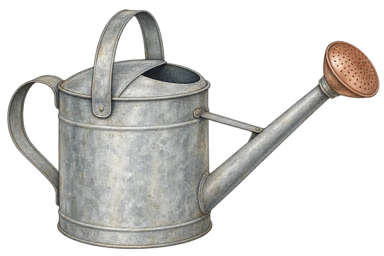
Watering-can and perforated-rose study
What it means: The historical clay pot and photographed metal cans are different objects. This illustration selects a generic metal type; the private collection documents visible functional variations without establishing one worldwide origin or a single maker.
Garden Museum preserves a seventeenth-century clay watering pot with a short spout and broad rose; its British-garden history is separate from the pictured metal type. RHS recommends an upward-facing rose for a gentle flow over newly sown seeds and small plants. Old Garden Tools directly photographs vintage metal watering cans, documenting complete functional variations.
Small, steady care helps things grow.
Often chosen for: Peace, calm & comfort · Care, gratitude & remembrance
Respectful use: The metal can is a generic functional-type interpretation, not a reconstruction of the separate historical clay pot or the unusual copper accession. Private-collector photographs support visible topology but are lower-resolution and do not establish fine fastening details, hidden threads, exact hole counts or maker history. The private owner retains all rights in the reference photographs, which were inspected only and are not included or copied. No current branded silhouette, exact stamped fittings, copied damage, global invention date or universal gardening practice is claimed. This is original generated decorative artwork, not an exact site survey, artifact replica or operating guide. Blue and gold are editorial colors. No institutional or community endorsement is claimed. No blanket commercial or manufacturing clearance is claimed.
Sources: [1] gardenmuseum.org.uk [2] rhs.org.uk [3] oldgardentools.co.uk [4] oldgardentools.co.uk