FRANCE; NINETEENTH-CENTURY OPTICAL-TOY HISTORY · OBJECTS
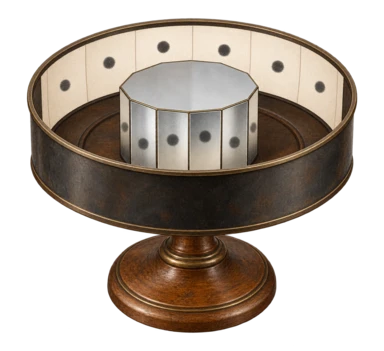
Praxinoscope mirror-drum study
What it means: Twelve picture positions are a selected historical configuration, with one corresponding mirror for each position. This static drawing uses a new abstract sequence and does not reproduce a particular maker's toy or establish a tested working animation.
The Science Museum records Charles-Émile Reynaud's praxinoscope as a nineteenth-century optical toy: pictures face inward around a rotating drum and each faces a central mirror. Their successive reflections create an impression of movement. Oxford's museum describes a twelve-frame configuration. This plain mechanism study uses a new abstract sequence, keeping the relationship between images and mirrors separate from the historic toy's characters and advertisements. Twelve picture positions are a selected historical configuration, with one corresponding mirror for each position. This static drawing uses a new abstract sequence and does not reproduce a particular maker's toy or establish a tested working animation.
A contemporary expression of movement built from small changes.
Often chosen for: New beginnings & hope · Care, gratitude & remembrance · Curiosity, creativity & wonder
Respectful use: Museum photographs and historical picture strips are not copied. The selected configuration is not a universal model, and no exact invention year is asserted. There are no maker initials, borrowed characters, advertisements or claims of a working optical demonstration. Source access and collection descriptions do not establish commercial image rights or manufacturing clearance. This is an original generated decorative study, not an exact map, site survey, historical artifact replica or operating guide. Blue and gold are editorial colors. No institutional or community endorsement is claimed. No blanket commercial or manufacturing clearance is claimed.
Sources: [1] collection.sciencemuseumgroup.org.uk [2] collection.sciencemuseumgroup.org.uk [3] mhs.ox.ac.uk