NATIVE FROM EUROPE TO THE WESTERN CAUCASUS; WOODLAND SETTINGS · NATURE
European wood-anemone study
What it means: Modern editorial interpretation: An editorial image of a place retaining traces of its earlier life.
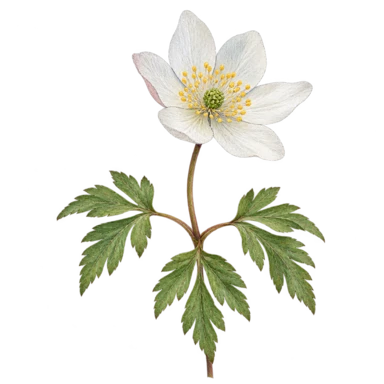
European wood-anemone, Anemone nemorosa, has a pale flower with petal-like sepals above a whorl of three divided leaf-like bracts. Its persistence can indicate places where woodland once stood.
A small woodland flower can remain after the trees have changed. This new motif offers a contemporary reflection on memory held in living places.
Often chosen for: Family, home & belonging · Care, gratitude & remembrance
Respectful use: The source calls these woodland ghosts in an ecological sense. Avoid converting that phrase into an invented spirit tradition; no harvesting or ingestion guidance. Taxonomic systems differ: the Kew backbone currently accepts Anemone nemorosa; retain its synonym for interoperability. The name here denotes the European species, not North American Anemone quinquefolia. Anemonoides nemorosa is retained as a taxonomic synonym where relevant. Woodland persistence is an ecological fact; memory is a contemporary personal interpretation. This is an original generated decorative study, not exact specimen, map, route or technical documentation. Blue and gold are editorial colors. Any personal reflection is contemporary interpretation; only explicitly bounded cultural context is documented. No blanket commercial or manufacturing clearance is claimed.
Sources: [1] kew.org [2] powo.science.kew.org [3] rhs.org.uk [4] pmc.ncbi.nlm.nih.gov