DJA FAUNAL RESERVE, CAMEROON · LANDSCAPES
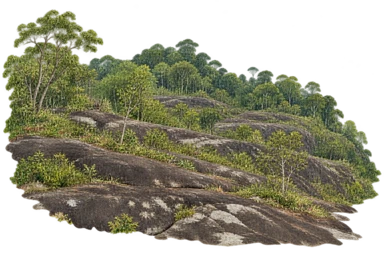
Dja rock-opening and forest-margin study
What it means: Baka communities are part of Dja’s living landscape. Their presence and agency are central to that context; this rock-and-forest study does not convey a traditional or sacred meaning or imply community endorsement.
Within Dja’s Congo Basin rainforest, exposed rock and shallow soils support openings of low vegetation beside denser forest. Botanical research describes these rock habitats as different from the surrounding humid forest. The reserve is also a lived landscape connected to Baka communities, whose livelihoods and participation matter to its conservation. This study follows a documented 2006 rock-and-forest view without naming its plants or exact outcrop.
Different ways of growing can share one landscape.
Often chosen for: Care, gratitude & remembrance
Respectful use: This is a dated 2006 rock-and-forest habitat component, not a reserve map, river scene, named outcrop, geological cutaway or current ecological survey. The botanical report supports rock-habitat context without identifying this photographed location or its species. Baka communities have living presence and agency; no cultural design, sacred belief, community endorsement or empty-wilderness story is attributed. No people, sensitive wildlife locations, patrol information, institutional marks or donation claim appear. Reference photographs are inspection-only, and their stated licenses do not establish general artwork, protected-area or community permission. This is original generated decorative artwork, not an exact site survey, artifact replica or operating guide. Blue and gold are editorial colors. No institutional or community endorsement is claimed. No blanket commercial or manufacturing clearance is claimed.
Sources: [1] whc.unesco.org [2] awf.org [3] whc.unesco.org [4] whc.unesco.org