EUROPEAN OPTICAL-INSTRUMENT HISTORY; SCIENCE MUSEUM COLLECTION EXAMPLE · OBJECTS
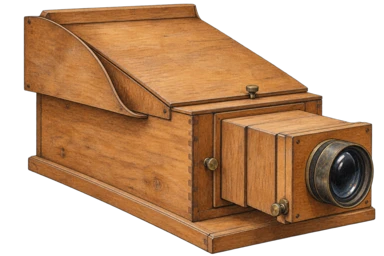
Box camera-obscura exterior study
What it means: The documented function connects optical observation with drawing by hand. The chosen exterior keeps the internal mirror and top screen concealed, so their historical role is explained in words rather than reconstructed in the image.
The Science Museum preserves a box camera obscura made before 1753, with unknown maker. Its lens and internal angled mirror directed an image onto a ground-glass screen at the top so a drawing could be traced. The museum cautiously suggests that it once belonged to Stephen Demainbray; ownership is not certain. This is a story about looking and drawing, without assigning invention to the maker of this box.
A modern invitation to look carefully before making a mark.
Often chosen for: Care, gratitude & remembrance · Curiosity, creativity & wonder
Respectful use: A plain original exterior study informed by Science Museum accession 1927-1139, rather than a replica. The maker is unknown and possible Demainbray ownership remains tentative. The before 1753 object date is not the date of the undated collection photographs. The nested drawtube, lens and shading cover are visible; the internal mirror and screen are concealed, with no invented cutaway. No later bellows camera, photographic print, maker plaque, optical-accuracy or single-inventor claim. Source photographs remain inspection-only; historical age and museum display do not establish commercial or image-reuse permission. This is original generated decorative artwork, not an exact artifact replica, site survey or operating guide. Blue and gold are editorial colors. No institutional or community endorsement is claimed. No blanket commercial or manufacturing clearance is claimed.