INTERNATIONAL ROPE-MAKING PRACTICE; UK REPLICA AND NORWEGIAN TECHNICAL EVIDENCE KEPT DISTINCT · OBJECTS
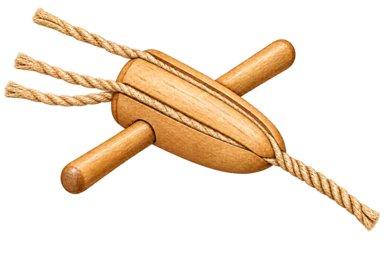
Rope-laying top and three-strand study
What it means: Museum Wales identifies its three-groove example as a replica. Hardanger’s documentation and process photograph show ropemaking as a continuing skilled practice. The original study draws on the tool relationship without claiming one historical accession or treating every rope as three-strand.
A laying top separates prepared strands while they are closed into rope. Museum Wales describes a three-groove replica, while a ropemaker-authored Hardanger report and official process photo explain the working relation. The new study is a generic tool-and-process illustration, not a portrait of that replica or a claim that all rope uses three strands.
Different strands can find strength in a shared direction.
Often chosen for: Friendship & connection
Respectful use: The Welsh collection object is a replica and the Norwegian sources document different working tools; their identities are not combined. Three exterior strand routes are one selected construction, not a universal rule for rope. Natural occlusion is retained rather than inventing visible hidden grooves. This finite decorative sample is not a working tensioned ropewalk or guidance for manufacture, climbing, lifting or load capacity. This is original generated decorative artwork, not an exact site survey, artifact replica or operating guide. Blue and gold are editorial colors. No institutional or community endorsement is claimed. No blanket commercial or manufacturing clearance is claimed.
Sources: [1] museum.wales [2] thedockyard.co.uk [3] fartoyvern.no [4] fartoyvern.no