MANCHESTER INSTRUMENT-MAKING CONTEXT, 1855–1865 · OBJECTS
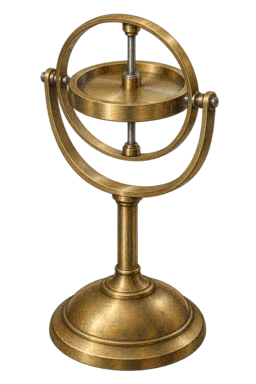
Nineteenth-century pedestal gyroscope
What it means: Science Museum Group Y1997.6.6 is attributed to John Benjamin Dancer in Manchester, 1855–1865, with a gift credit to the Manchester Literary & Philosophical Society. A separate 1883 Dumoulin-Froment apparatus in the collection demonstrated Earth’s rotation; this study does not reconstruct that experiment.
A gyroscope has a rotor supported by pivots. This pedestal study depicts a solid dished rotor on an axle, held in one circular bearing ring and an open U-shaped cradle.
Notice the reference points within the motion.
Often chosen for: Peace, calm & comfort · Curiosity, creativity & wonder
Respectful use: This whole instrument type follows the inspected Dancer pedestal configuration, with a solid rotor, opposed axle bearings, a single complete bearing ring, an open U cradle and a complete stem and foot. It does not depict a globe, transparent sphere, clock, armillary or two complete gimbal rings. The separate 1883 apparatus, its suspension, microscope and spinning-up mechanism are not transferred to this form. Making dates do not date the undated photographs. This image makes no calibrated-function, navigation, perfect-fixity or perpetual-motion promise. The museum’s image terms and separate catalogue-data terms do not establish commercial, institutional or manufacturing permission. Source images remain inspection-only. Original generated decorative artwork, without a replica, working-instrument or institutional-endorsement claim. Blue and gold are editorial colors. No blanket commercial or manufacturing clearance is claimed. Legal and community review remain separate.
Sources: [1] collection.sciencemuseumgroup.org.uk [2] collection.sciencemuseumgroup.org.uk