NATIVE TO PARTS OF FRANCE, ITALY AND SPAIN; CULTIVATED WIDELY · NATURE
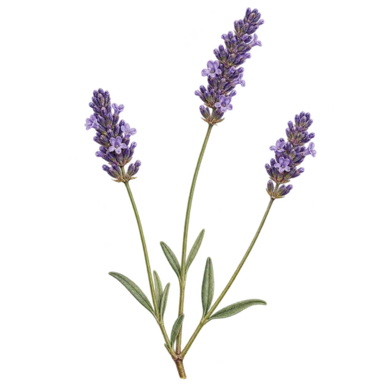
English-lavender flower-spike study
What it means: Kew discusses lavender’s twentieth-century LGBTQIA+ associations and the color’s use for empowerment, remembrance and resistance. This optional historical context does not imply one meaning for every lavender flower or wearer.
English lavender has narrow leaves and small flowers gathered toward the tops of slender stems. This Lavandula angustifolia-informed study shows three unequal terminal spikes with low gray-green foliage; purple describes the natural-color flowers. Kew discusses lavender’s twentieth-century LGBTQIA+ associations and the color’s use for empowerment, remembrance and resistance. This optional historical context does not imply one meaning for every lavender flower or wearer.
Slender stems hold small clusters of color. This editorial motif can invite a pause, or express self-possession, without promising a therapeutic effect.
Often chosen for: Peace, calm & comfort · Strength & courage · Curiosity, creativity & wonder
Respectful use: This study is not French lavender with prominent top bracts. Small florets are decoratively simplified rather than microscopic anatomy diagrams. No sleep, anxiety-treatment or other therapeutic claim is made. No personal identity, sexuality or community endorsement can be inferred from selecting this motif. The blue/gold edition is an ornamental palette rather than a literal lavender-color signal. This is an original generated decorative study, not exact specimen, map, route or technical documentation. Blue and gold are editorial colors. Any personal reflection is contemporary interpretation; only explicitly bounded cultural context is documented. No blanket commercial or manufacturing clearance is claimed.
Sources: [1] rhs.org.uk [2] kew.org