MANY TEMPERATE AND TROPICAL REGIONS; CHINESE CULTURAL CONTEXT SEPARATELY DOCUMENTED · NATURE
Cicada emergence study
What it means: The Smithsonian National Museum of Asian Art describes a specific Han-dynasty funerary association: jade cicada amulets placed on the deceased’s tongue expressed hopes for rebirth and immortality. This historical context is separate from the natural animal illustration.
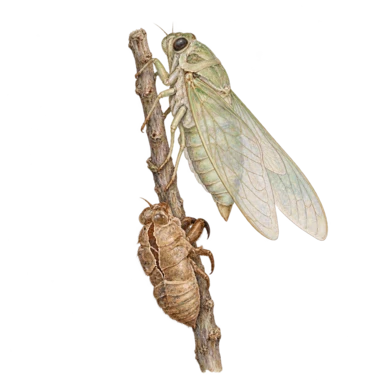
Cicada nymphs develop underground before emerging and leaving their nymphal exoskeleton. This study pairs a newly emerged, resting adult with expanded wings beside its empty exuvia; species, brood and period length are unspecified. The Smithsonian National Museum of Asian Art describes a specific Han-dynasty funerary association: jade cicada amulets placed on the deceased’s tongue expressed hopes for rebirth and immortality. This historical context is separate from the natural animal illustration.
An adult emerges from the shell of an earlier stage. This new study can carry a contemporary message of renewal without suggesting that every cicada spends seventeen years underground.
Often chosen for: New beginnings & hope · Peace, calm & comfort
Respectful use: The Chinese rebirth association has a funerary context and should be explained sensitively. Do not use a museum burial object as a template or impose this symbolism on every audience. The animal is not a copy of a jade burial object. The funerary association is contextual rather than universal, and does not identify this generic cicada as Asian. No seventeen-year cycle or dew-feeding claim is made. This is an original generated decorative study, not exact specimen, map, route or technical documentation. Blue and gold are editorial colors. Any personal reflection is contemporary interpretation; only explicitly bounded cultural context is documented. No blanket commercial or manufacturing clearance is claimed.