CHINA; ZHUSUAN KNOWLEDGE AND PRACTICE · OBJECTS
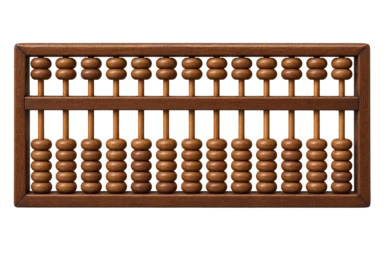
Chinese suanpan 2:5 study
What it means: The museum image verifies a thirteen-rod 2:5 frame; Smithsonian’s official indexed account explains the familiar upper-five/lower-one bead values. No displayed arrangement is presented as a solved equation, and neither the accession number nor a broad statement about base 16 is turned into a universal invention or arithmetic claim.
Zhusuan is the learned practice of calculating by moving abacus beads according to established rules; UNESCO describes oral formulas as part of how that knowledge is transmitted. The selected physical form is a Chinese suanpan with two beads above its divider and five below on each rod, as seen in the Science Museum’s wooden example. The tool and the living calculation practice are related but not interchangeable. The museum image verifies a thirteen-rod 2:5 frame; Smithsonian’s official indexed account explains the familiar upper-five/lower-one bead values. No displayed arrangement is presented as a solved equation, and neither the accession number nor a broad statement about base 16 is turned into a universal invention or arithmetic claim.
A modern reminder that practice can turn small steps into fluency.
Often chosen for: Curiosity, creativity & wonder
Respectful use: The Science Museum page and actual photo were read directly; Smithsonian and UNESCO practice details retain explicitly labelled official-index support because direct retrieval returned 404 or a shell. Museum photo licence is CC BY-NC-SA 4.0 and is inspection-only; no exact specimen trace. No numerical, therapeutic, cognitive, authenticity or manufacturing guarantee. This is an original generated decorative study, not an exact map, site survey, historical artifact replica or operating guide. Blue and gold are editorial colors. No institutional or community endorsement is claimed. No blanket commercial or manufacturing clearance is claimed.
Sources: [1] collection.sciencemuseumgroup.org.uk [2] si.edu [3] ich.unesco.org