NINETEENTH-CENTURY BICYCLE HISTORY; BRITISH MUSEUM CONTEXT · OBJECTS
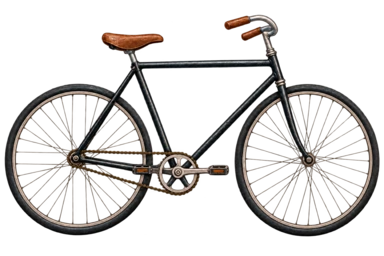
Chain-driven safety-bicycle study
What it means: The 1885 Rover's curved tubes and the 1890 Humber's straighter frame are different documented examples. This original later diamond-frame type combines general safety-bicycle structure without reproducing either machine. The historical mobility story remains bounded by affordability and social access rather than a universal claim of liberation.
Rear-wheel chain drive helped bicycle designers place riders lower between two smaller wheels. The Science Museum connects the late-nineteenth-century bicycle boom with greater independent mobility for some women, while noting that cost limited access. This unbranded type study focuses on the two-wheel frame and drive relationship, rather than assigning the invention to one machine or presenting mobility as equally available to everyone.
A contemporary expression of finding movement under your own power.
Often chosen for: New beginnings & hope
Respectful use: The unbranded drawing does not copy a museum photograph, replacement saddle, maker badge, racing colors or expedition bicycle. Its two opposed cranks and chain drive are a simplified nearly side-on mechanism study, not a roadworthy design, riding instruction, safety certification, patent assessment or blanket commercial clearance. This is an original generated decorative study, not an exact map, site survey, historical artifact replica or operating guide. Blue and gold are editorial colors. No institutional or community endorsement is claimed. No blanket commercial or manufacturing clearance is claimed.
Sources: [1] blog.sciencemuseum.org.uk [2] collection.sciencemuseumgroup.org.uk [3] blog.sciencemuseumgroup.org.uk