INDIAN SUBCONTINENT; CULTIVATED IN TROPICAL REGIONS · NATURE
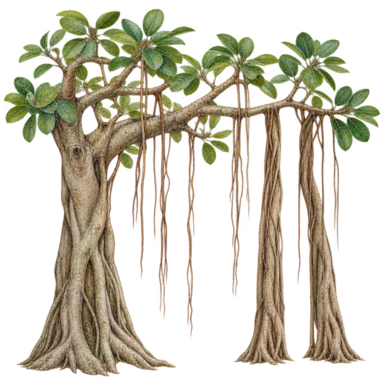
Banyan aerial-root canopy study
What it means: Kew records banyan's sacred status in Hindu and Buddhist contexts in India and its frequent planting near temples. This is a geographically bounded context, not one universal symbolic meaning.
Banyan roots can descend from branches and develop into additional supporting trunks after reaching the ground. This compact canopy-and-support study emphasizes roots beginning overhead, with open gaps between them. Kew records banyan's sacred status in Hindu and Buddhist contexts in India and its frequent planting near temples. This is a geographically bounded context, not one universal symbolic meaning.
A branch sends a root downward, and another support can begin. This modern study can express a widening circle of care without claiming one tree speaks for every tradition.
Often chosen for: Family, home & belonging · Strength & courage
Respectful use: Ficus benghalensis is not the bodhi tree Ficus religiosa. Sacred associations deserve contextual respect; do not use deity imagery or ritual promises, or assume universal beliefs. The form is Ficus benghalensis-informed rather than species-diagnostic. It is not Ficus religiosa, the bodhi tree. No named heritage tree, temple, deity image, ritual promise, sacred efficacy or community endorsement is depicted or claimed. This is an original generated decorative study, not exact specimen, map, route or technical documentation. Blue and gold are editorial colors. Any personal reflection is contemporary interpretation; only explicitly bounded cultural context is documented. No blanket commercial or manufacturing clearance is claimed.
Sources: [1] powo.science.kew.org